Contacts

Storiadellarte.com: italian art history

Periods
Byzantine Art
Byzantine Art
Romanesque Art
Romanesque Art
arte gotica
Gothic Art
Renaissance Art
Renaissance Art
Renaissance 400
Renaissance 500
mannerism Mannerism
Baroque Art
Neoclassical Art
Neoclassical Art
Romantic Art
Romantic Art

Sections
painting
Painting
sculpture
Sculpture
architecture
Architecture
biography
Artist biography

In Italy
musei
Museum
teatri
Theatre
alberghi
Hotels

Community
newsletter
Newsletter
articoli
Article

Link
link
Friends
link
Link consigliati

Picture of Italy
Images, photo, landscape of Italy

Montagna in Italia

Anno Paolino

Michelangelo

Michelangelo Buonarroti was born in Caprese, in the Val Tiberina, on 6th March 1475.
His family was one of the lesser noble families and this allowed Michelangelo to attend Domenico Ghirlandaio’s school, although he never liked the man. A workshop did not suit Michelangelo who liked to work on his own. In these years he studied Florentine XV century arts and the works of painters like Filippo Lippi, Gentile da Fabriano, Verrocchio, Pollaiolo and especially Masaccio. After a year in Ghirlandaio’s workshop, Michelangelo left for the garden of the Medici family, where there was a collection of works of art, many old medallions and cameos. Here famous Italians met, including Angelo Poliziano, Pico della Mirandola and Marsilio Ficino. Here the artist’s idea of art’s beauty was born: for Michelangelo (as for other Renaissance artists) art is the imitation of nature and by studying nature beauty is achieved in art. Unlike other artist Michelangelo did not believe in representing nature as closely as possible; he preferred to look at the best parts of nature and create beauty which was superior to nature’s beaty.
La PietàIn 1496 he left Florence and moved to Rome, where cardinal Jean Bilheres commissioned the Pietà. The work of sculpture shows the Madonna with a lifeless Christ in her arms. For Michelangelo the art of sculpture was a special art which allowed the artist to free the figures which were trapped in the marble block. For this reason he considered carving stone “a way of removing” splinters of marble from the block.
In 1501 he was back in Florence and received a commission for a statue of David which was to be placed in the duomo. He was given a block of marble previously Il Davidused by Agostino di Duccio.
The statue is of David in the instant before throwing the stone: tension and concentration are clearly visible in the tensed muscles and bulging veins. The statue was placed in front of Palazzo Vecchio; it is now in the Accademia of Belle Arti and a copy was been put in its place.
In Florence he painted a plate with the Holy Family for the wedding of Agnolo Doni; the plate is known as Tondo Doni. The bodies’ iridescent colours are like statues; in the fore ground is the Holy Family and behind them, on a low wall, is St Giovannino. Behind the latter, in the background, there are naked young men, considered precursors of Prisons (painted in the mausoleum of Julius II).
In 1503 Michelangelo went back to Rome where Pope Julius II della Rovere commissioned his mausoleum; the artist worked on it from 1503 to 1545.
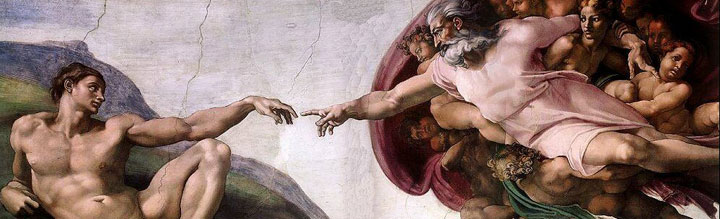
La Creazione di AdamoIn 1508 he received a commission for the frescos of the Sistine Chapel (he worked on them till 1512).
The vault is decorated with false architecture and the pendentives show Judith and Olophernes, David and Goliath, the Brazen Serpent and the Punishment of Amon. The lower part of the vault is decorated with Prophets and Sybils. The central part is divided into nine parts, separated by arches, marble frames and bronze medallions depicting scenes from the Bible, with the Creation of Adam in the central part.
Shortly after the death of Julius II Michelangelo finished carving the Rebel Slave, the Dying slave and Moses in St Peter in Chains.
The new Pope, Leo X, sent Michelangelo to Florence to complete the façade of St Lorenzo and to build the New Sacristy, the Library and the Tombs of the Medici (for these he carved the statues of Day and Night).
In 1534 he settled in Rome permanently and accepted the commission for painting the Last Judgement in the Sistine Chapel.
After Bramante’s death a number of architects tried to end the project of St Peter’s and in 1547 Paul III gave Michelangelo the task. The architect worked on the apse but the building was completed after his death, with the construction of the dome he had designed (which was probably modified).
His last work is Pietà Rondanini, which he did not finish and is today in the Sforza Castle in Milan.
Michelangelo Buonarroti died on 18th February 1564 in Rome, in his house near Trajan’s Forum.


Guida d'Italia
guida d'italia
The web site guidaditalia.com offers information about Italian towns, history, art, culture, tourist information, museums, theatres, hotels, tourist and agricultural resorts, B&Bs and lots more...
Guida d'Italia
Italian version
English version
Search
Web
Storiadellarte
Deepenings
Images
Fonti

Focus
maldive
Maldive
acciaroli
Acciaroli

Copyright Storiadellarte.com

Contacts- Newsletter - Guida d'Italia - Hotel online reservations -

copyscape